How to Create a Content Calendar That Converts?
April 01, 2026
Most creators treat a content calendar like a nicer to‑do list. Dates. Deadlines. Maybe a few ideas dropped into empty cells. It feels organized, but it does not change the quality of the content or the results it delivers. It just helps you publish more of the same.
The shift happens when you stop seeing the calendar as a scheduling tool and start using it as an operating system. An operating system connects every action to a purpose. It defines how decisions are made, how data moves, and how work flows from idea to outcome. When your calendar works this way, it becomes the spine of your content strategy, not the wrapper.
In that model, a post is never just a post. It is a deliberate bet on a specific audience, on a specific platform, at a specific time, in a specific format, with a specific business outcome in mind. The calendar is where all of those decisions live in one place.
This article walks through how to design that kind of calendar. We will look at timing as a strategic decision, not a habit. We will dig into format as a platform decision, not a repurposing reflex. We will look at why knowing who you are writing for changes everything about how content lands. Then we will look at how smart allocation across platforms lets you reach more people without producing more content.
By the end, you will have a mental model and a practical framework for turning your calendar into a simple, specific operating system that can guide 30 days of content at a time without burning you out or diluting your message.
Strategic Timing: Turning Posting Windows Into Probability Gains
Most advice about "best times to post" stops at generic rules. Mornings for LinkedIn. Evenings for Instagram. Weekdays for B2B. Those patterns are a shallow summary of a deeper point: timing is about probabilities, not habits.
Every platform has windows where your audience is not just online but paying attention. Those windows shift by Platform, Audience type, Day of week Treat your calendar as the place where you encode those patterns. Not as guesses, but as evolving hypotheses.
Think of each time slot as a probability statement: “At this time, on this platform, this audience is most likely to see and engage with this content.” Your job is to map each piece of content to the window where that probability is highest. Here is how that looks in practice:
1. Separate timing logic by platform
What works on LinkedIn on Tuesday at 9 a.m. does not map neatly to TikTok or Instagram. Audience behavior is platform specific. Your calendar should reflect that by showing:
- LinkedIn: posts clustered around workday focus windows
- Instagram: more attention to evenings and weekends
- X: tighter, more frequent blocks across the day
Avoid the common shortcut of mirroring one schedule across all channels. That shortcut is expensive in lost reach.
2. Assign a primary time window to each post
In your calendar, each planned piece should have:
- Platform
- Date
- Primary time window (for example, 8:30–9:30 a.m.)
Treat time as part of the content decision, not an afterthought.
3. Use performance as feedback, not judgment
When a post outperforms or underperforms, do not only ask, “Was the idea good?” Also ask, “Was this the right window for this audience on this platform?” Timing becomes another lever to adjust, not just a constraint to work around. Over time, your calendar stops being a static schedule. It becomes a living record of what timing decisions produce the most attention from the right people.
Format as Function: One Asset, Multiple Platforms
Creators often talk about “repurposing” as if copy‑paste efficiency is a strategy. The same idea gets pushed to LinkedIn, Instagram, TikTok, and X with minor tweaks to length or caption style. On the surface, this feels smart and scalable. In practice, it spreads one idea thin and underperforms everywhere.
The real work is not repurposing. It is reframing. The underlying idea stays the same. The expression shifts to match the platform, the audience, and the format that works there. And critically, you do not need to build a separate asset for every platform to do this well. Your calendar is where you decide those roles.
A well-structured calendar assigns each piece of content a primary platform where the full asset is created, and secondary platforms where the same content is adapted in tone, length, and framing. One creative session. Multiple platform expressions.
Consider one idea: "Why most teams waste their best content."
Primary: LinkedIn
- Full post, three insights, closing question
- Built for the decision-maker scrolling between meetings
Secondary: X
- First insight only, sharpened to one punchy line
- Same idea, stripped to its core for a faster-moving feed
Secondary: Instagram
- Caption pulls the most visual moment from the LinkedIn post
- Same message, framed around what the image carries
The asset is created once. The reach multiplies without multiplying the production time.
When your calendar specifies this in advance, production becomes execution rather than invention. You are not staring at a blank page asking what to make. You are answering a much clearer question: how do I adapt what has already been decided for this specific platform and this specific audience? That shift, from creation to adaptation, is where the real efficiency lives. And it only happens when the calendar does its job before the writing starts.
Mapping Every Piece to a Clear Job
If your content always sounds like you are introducing yourself to strangers, your funnel has a hole. Most creators never assign each piece of content a clear job within the buyer relationship, and it shows.
Knowing who you are writing for and where they are in their relationship with you changes everything about how a piece of content reads. Without that clarity, content defaults to broad messages aimed at everyone. That feels safe. It is also why engagement plateaus.
That specificity is what gets content saved, shared, and acted on.
The Hidden Math of Multi-Platform Reach
Most creators assume that reaching five platforms means producing five times the content. That assumption is what makes multi-platform strategy feel unsustainable before it even starts. It is not a volume problem. It is an allocation problem.
The question a well-designed calendar answers is not "what do I post on each platform?" It is "what is the minimum number of content pieces I need to produce this month to meet my reach goals across every platform I care about?"
Those are very different questions, and the second one has a real answer. It depends on your posting frequency targets per platform, which days you are willing to post, how your content types are distributed, and how secondary platforms can absorb adapted versions of primary assets without requiring entirely new creative work.
When a calendar is built around that logic, the output is a schedule that covers your platforms, hits your frequency targets, and does so with the least possible number of distinct content pieces. You produce less. You reach more. The creative energy you save goes into making each piece better rather than just making more of them.
Most creators never get here because the planning required to figure this out manually is itself a full-time job. A calendar that does this math for you before you write a single word is not a convenience. It is the difference between a content practice that scales and one that burns you out by week three.
Key Takeaways
· A content calendar is most powerful when treated as an operating system, not a scheduling spreadsheet. It should connect what you publish to why, for whom, and toward which business goal.
· Timing is a strategic decision, not a gut call. Map each piece of content to platform-specific windows where your audience is most likely to be active and paying attention.
· Format is a functional choice tied to each platform's norms. One primary asset, adapted for secondary platforms, is more sustainable and more effective than building something new for every channel.
· Knowing who you are writing for and where they are in their relationship with you changes everything about how a piece of content reads. That specificity is what drives real engagement.
· The goal of a well-designed calendar is not more content. It is the minimum content needed to reach your audience across every platform you care about, without burning out the person producing it.
Actionable Next Steps
· Audit your last 30 days of content. For each post, note the platform, the day and time, and honestly assess who it was written for and what it was trying to accomplish. Patterns will surface quickly.
· Add mandatory fields to your calendar template. Platform, posting time, content type, target audience, and business goal should be answered for every row before anything gets written. Leaving this blank is how generic content happens.
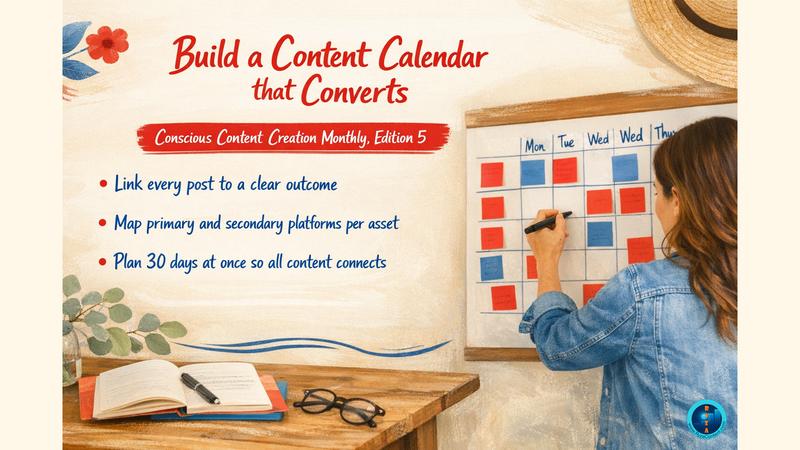
· Plan a full month in one sitting. Map goals, platforms, and formats before you open a single blank document. Every row in your calendar should function as a brief you execute later, not a reminder you interpret on the fly.
· Review results monthly. Look at which combinations of platform, time, content type, and audience actually moved your business goals. Adjust the next month based on what you learn, not on what feels right.
Bringing it all together
A content calendar that only tracks posting dates can help you stay visible. It cannot make your content meaningful, consistent, or effective on its own. That happens when the calendar stops being a log and starts being an operating system.
In an operating system model, every piece of content is intentional. Timing is chosen, not guessed. Format is designed to fit the platform and the job. Business goals are defined before you write, not tacked on at the end with a generic call to action.
The beauty of this approach is that it does not require massive complexity. The most effective calendars are simple and specific. They answer the same small set of questions for every piece of content: what, when, where, for whom, in what voice, and toward what goal. When those answers line up across a full month, your content stops feeling like a series of disconnected posts and starts working as a coherent system.
As you connect planning directly to production, you reduce friction and decision fatigue. As you treat content and platforms as variables in an optimization problem, you reclaim creative energy for the work that actually requires your judgment. Over a few cycles, you will find that your calendar is no longer something you maintain for its own sake. It becomes the core of how you make content decisions and, eventually, how you grow your business.
That is the difference between staying active and actually growing.
Implementation Guide
1. Standardize your calendar fields: Create or update your calendar template so every row includes platform, date, time window, theme, format, and target goal. This structure is non‑negotiable.
2. Run a 30‑day pilot: Commit to one 30‑day cycle using the operating system approach. Plan the full month in one session, then execute without re‑deciding strategy mid‑stream.
3. Integrate with your drafting process: Wherever possible, link each calendar item directly to a document, script, or design file, so you move from planning to production without rebuilding context.
4. Evaluate by business outcome: At the end of the month, review not just likes or views, but which posts contributed to leads, inquiries, or relevant audience growth, based on the goals you assigned.
5. Iterate and simplify: Use your findings to refine themes, timing windows, and platform focus. Remove low‑value patterns. Keep the structure tight so the calendar remains a clear, reliable operating system, not a cluttered archive.
Every decision described in this article is pre-mapped for every day of your month in Ryza Content's calendar: primary and secondary platforms, posting times per platform, content type, visual format, theme, audience, brand voice, and business goal. And it is all done using precision analytics to ensure you get the maximum reach with the minimum production time for your intended audiences. You set up your inputs once a month and thereafter each day opens as a ready-to-go brief. You generate, refine, and post.