
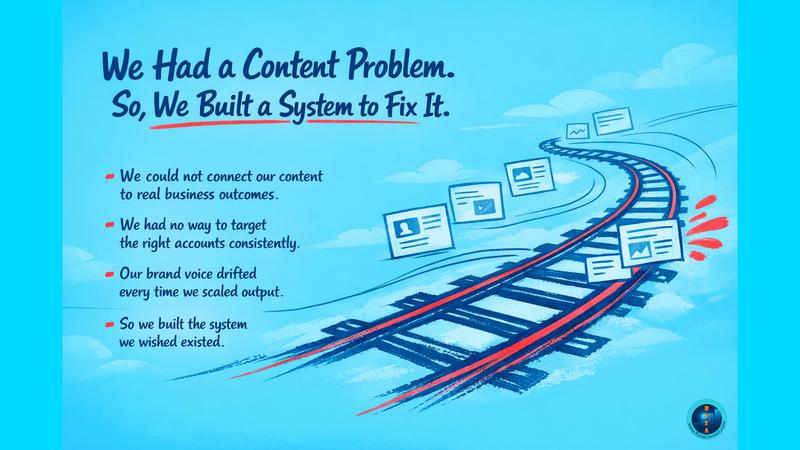
We Had a Content Problem. So We Built a System to Fix It.
April 09, 2026
Most teams still treat content like a series of favors. A blog here. A sales one-pager there. A last‑minute deck for a pitch that “just landed”. It feels busy, but it rarely feels fair to the business, the creator, or the risk you take with every message you ship.
The deeper problem is simple. Content work is often ad hoc and unmeasured. There is no shared track. No clear way to connect that newsletter or LinkedIn post to real business outcomes like qualified pipeline or revenue. The result is tension between creative teams and leadership. Creators talk about stories. Executives talk about data. Both are right, but they are not working from the same system.
Ryza is built to fix this. It treats content as a measurable operating system for how your business speaks to its market. Instead of random tasks, you get a repeatable, data-informed engine that respects your brand voice while pointing every asset at specific KPIs. Think of it as high-speed rail for content. You choose the destination and the car. Ryza lays the track, controls the speed, and makes sure you never jump the brand voice.
In this article, we will walk through how Ryza turns messy creation into a disciplined business system. We will look at its data-informed framework, its KPI and funnel alignment, and how it connects content directly to target accounts. We will also dig into the guardrails that reduce risk and the research transformation system that turns chaotic inputs into usable assets. Finally, we will close with a practical guide for putting this approach to work in your own organization.
Turning Ad Hoc Content Into an Operational Framework
Most content teams operate on gut and urgency. Someone needs something, so you make it. That pattern feels responsive, but it hides risk. You cannot measure what is not mapped. You cannot optimize what does not run on a track.
Ryza starts by treating content as an operational system. It maps inputs, workflows, and approvals so publishing follows a predictable rhythm instead of random requests. This is not about more process for its own sake. It is about turning creative energy into repeatable value.
At the core is a data-informed framework. Ryza uses data science and leadership‑defined boundaries to shape how content flows. You define what “on track” means in your environment. That includes who requests content, who approves it, how it moves across teams, and how finished pieces are tied back to business goals. This framework has three practical impacts:
1. Clarity of roles
Everyone knows their part in the system. Creators focus on insight and narrative. Stakeholders focus on direction and acceptance. Nobody is confused about who owns risk for claims, accuracy, or timing.
2. Predictable publishing rhythm
Because workflows are mapped, you can forecast. You know when drafts will land, when approvals are due, and how often specific channels will see new content. That rhythm directly reduces tension between sales, marketing, and leadership.
3. Structured data capture
Every content run becomes a data event. You track not just output volume, but also how work moved through the system, where it slowed, and which pieces tied to which outcomes. Content is no longer a creative black box. It is a business process that can be measured and improved.
By framing content as an operating system instead of one-off deliverables, Ryza gives teams a fair structure. Creators are not asked to be magicians on demand. They are asked to contribute insight into a measurable system that respects risk, time, and brand.
Aligning Content With KPIs and Funnel Stages
A major reason content feels “soft” is the lack of clear targets. Teams talk in general terms: “build awareness,” “educate the market,” “support sales.” Helpful intentions, but not measurable. Ryza makes you pick a lane.
Every content run in Ryza is oriented around a primary KPI. That might be qualified leads, revenue growth, new customer acquisition, or another clear business outcome. You choose it up front. The system then frames ideation, structure, and distribution around that target.
This matters for two reasons. First, it reduces internal debate. Instead of arguing about style or preference, you evaluate pieces against the chosen KPI. Second, it guides form and format. Content meant to create qualified leads will look different from content meant to support post‑sale retention.
Alongside KPI alignment, Ryza forces clarity on funnel stage. This funnel targeting keeps your portfolio balanced. Are you over‑invested in awareness posts that never move readers to decision? Are you neglecting post-sale content that could reduce churn and deepen trust? With clear stage mapping, you can see the gaps.
In practice, this creates a more disciplined content grid:
- Awareness content introduces your worldview and category. It trades on clarity, not complexity.
- Consideration content dives into comparisons, use cases, and objections.
- Decision content supports late‑stage risk: proof, detail, and confidence building.
- Post-sale content helps customers get value and spot new opportunities.
- Storytelling content deepens narrative intelligence. It connects your brand to real human stakes and context.
By tying every piece to a KPI and a funnel stage, Ryza makes performance traceable. You move from “we posted a lot” to “this series contributed to this part of the pipeline.” That shift is where content starts to look like a business system, not an art project.
Connecting Content Directly to Target Accounts and Revenue
Most content platforms stop at creation and scheduling. They rarely answer the simple question: “Who is this content for in real business terms?” Ryza tackles that head-on by linking content directly to Ideal Customer Profiles and target companies.
Each month, business users receive a curated list of up to 50 ICPs and target companies. These profiles are tied to your actual products and services, not a generic segment description. That list is not just a sales artifact. It becomes the spine of your content runs.
Here is how that plays out operationally:
1. ICP-informed topics: Instead of guessing what to write about, you target the real problems those 50 accounts are likely facing. Your messaging leans into their language, their risk, their buying context.
2. Pipeline-oriented series: With clear targets, you can plan content sequences aimed at moving specific types of buyers from Awareness to Decision. For example, a set of posts, a newsletter, and a sales one‑pager all designed to warm a cluster of accounts in the same vertical.
3. Faster feedback from sales: Because content is tied to clearly named targets, sales teams can respond with detail. “This series helped open three conversations” is more useful than “Marketing is doing a good job lately.”
The outcome is a tighter link between creative output and revenue. You are not simply hoping that strong ideas find their way into the right inboxes. You are building a content rail that runs directly through your target market.
This targeted approach also sharpens your risk lens. When you know exactly which accounts will see a narrative, you are more precise about claims, promises, and data references. That aligns with Ryza’s focus on fair treatment of both your audience and your own brand.
Guardrails That Protect Voice, Quality, and Compliance
Speed without guardrails is risk. It is easy for teams to lean on AI for volume and lose control of their voice, their promises, and their professional standards. Ryza was designed to keep that from happening.
First, there is voice training. Instead of asking AI to “sound like us,” you feed Ryza a structured “voice canon” of past content. This canon includes key phrases, tone preferences, and your unique terminology. Over time, the system uses this base to keep outputs from drifting into generic brand speak. Your content stays recognizably you, even as you scale.
Second, Ryza enforces daily creation limits. That might sound restrictive, but the intent is fair: prevent volume from eroding quality. When there is a hard ceiling on output, teams must prioritize. They choose the runs that best match current KPIs and funnel gaps instead of flooding channels just to feel productive.
Third, Ryza includes compliance oversight baked into workflows. That can mean:
- Required approval steps for regulated claims
- Structured review paths for legal or compliance teams
- Clear logs of who changed what, and when
This structure turns compliance from a last-minute roadblock into a predictable part of the system. Content can move fast without skipping critical checks that protect your brand and your customers. Together, these guardrails reduce three forms of risk:
- Voice risk: sounding unlike yourself, eroding trust over time.
- Quality risk: shipping rushed assets that confuse or mislead.
- Compliance risk: missing required checks and creating exposure.
The result is a more confident engine. Creators can push into new stories and new formats, knowing that the system will keep them on track. Leadership can see that speed does not mean cutting corners. The tension between “go faster” and “stay safe” becomes more manageable because the rails are visible and agreed.
Turning Messy Research into Repeatable Content Assets
Raw research is one of the most underused assets in most companies. Subject‑matter experts collect PDFs, internal reports, decks, screenshots, and field notes. Then they run out of time. The insights stay trapped in files instead of reaching the market.
Ryza addresses this with a research transformation system. Instead of asking experts to become writers, it lets them feed messy inputs directly into the platform. That can include PDFs, images, data snippets, or other research artifacts. Ryza then helps turn those into structured content runs. Here is how it plays out:
1. Centralize the mess: Experts drop their materials into Ryza without pre‑formatting. The goal is to capture the real substance, not a cleaned‑up version.
2. Extract the signal: Ryza analyzes the material for key themes, data points, and story angles. It respects the original voice canon and the business KPIs defined for the run.
3. Generate asset plans: From the same research base, the system outlines post series, newsletters, and sales one‑pagers. Each asset is aligned to specific funnel stages and ICP needs.
4. Loop in experts where they add most value: Instead of rewriting content, experts review for accuracy, nuance, and risk. Their time is spent at the level of insight, not formatting.
The benefit is a fairer deal for expertise. Your sharpest minds do not have to learn copywriting on nights and weekends. They feed their best thinking into a system built to respect their time and amplify their impact.
This research transformation also builds compound value over time. As more material flows through Ryza, the system develops a richer understanding of your domain language and proof points. That deepens your narrative intelligence and makes future content even more precise.
Case Study: How Ryza Got Its Tools
We built Ryza out of every marketing challenge we faced with our own products and services. We kept asking whether our problem was "better content" or "more consistent content”, but we could not define what either meant in concrete terms. That is where the idea of a measurable content system entered the early thinking behind Ryza.
We started by defining primary KPIs with a clear goal: increase qualified leads into our pipeline for one core offer. Then we mapped our funnel stages and found an obvious gap. We were producing plenty of awareness content and product sheets, but almost no structured consideration or decision content that spoke directly to target accounts.
That gap led us to build the Target Companies tool, designed specifically around identifying ICPs and their pain points with precision. These accounts align with our strongest product fit. Using Ryza, we planned a content run focused on consideration for this group: a post series explaining use cases, a newsletter distilling key tips, and a sales one-pager tailored to common objections.
We uploaded existing internal decks and PDFs directly into Ryza. The system extracted key points and transformed them into planned assets while preserving our brand voice and terminology. Compliance steps were embedded in the workflow so that clients needing legal or managerial review could move through that process without last-minute surprises.
Within one cycle, the difference was clear. Prospects referenced specific posts and one-pagers in meetings and DMs. We could trace that activity directly back to the original KPI and funnel stage. Content stopped feeling like a vague support function and started operating like a business system, with clear tracks, guardrails, and a measurable return on expert time.
Key Takeaways
- Ryza treats content as an operating system, not scattered tasks. By mapping inputs, workflows, and approvals, it builds a predictable publishing rhythm that supports measurable business outcomes.
- KPI and funnel-stage alignment turn content from a vague visibility play into a directed engine. Each piece is tied to specific goals like qualified leads, revenue, or retention, and mapped to awareness, consideration, decision, post-sale, or storytelling.
- Targeted ICP lists connect content directly to real companies and buyers. Monthly lists of up to 50 accounts let teams craft sequences that move actual prospects, not abstract personas, through the buying journey.
- Guardrails for voice, quality, and compliance reduce risk as you scale. Voice training, daily creation limits, and structured oversight protect your brand’s distinct language and professional standards.
- The research transformation system turns messy expert material into usable assets. Experts focus on insight and accuracy while Ryza handles structuring posts, newsletters, and sales one‑pagers from raw inputs.
- Over time, this system compounds narrative intelligence. Each run strengthens your data, your language, and your ability to tell real, credible stories that align with measurable business goals.
Actionable Next Steps
1. Define a single primary KPI for your next content run: Choose one outcome like qualified leads or expansion revenue. Use it as a filter for every topic and format decision so you start building toward a measurable system.
2. Map your current content to funnel stages: Take inventory of existing assets and assign them to Awareness, Consideration, Decision, Post-sale, or Storytelling. Identify where you are thin and where you are overproducing.
3. List your top 30–50 target accounts or ICPs: Even before automation, draft a focused list of real companies that match your strongest fit. Use them as the test group for your next content sequence.
4. Create a lightweight voice canon: Gather 5–10 examples of content that feel “most like you.” Highlight key phrases, tone cues, and terms you always or never use. This becomes the base for any system, including Ryza, to mirror your voice.
5. Pilot a research-to-content workflow with one expert: Ask a subject‑matter expert to share raw material on a single topic. Turn it into a mini-series and a one‑pager, keeping them only in the review seat. Track how much time you save and how it affects quality.
6. Document a simple approval path with clear roles: Define who requests content, who approves it, and who checks for compliance. Even a basic map reduces risk and prepares you to plug into a platform like Ryza.
Conclusion
Content will always involve creativity, tension, and judgment. That is part of its value. But leaving it fully ad hoc is unfair to your team and your business. It hides risk, blurs ownership, and disconnects your stories from your pipeline.
Ryza offers a different path. By treating content as a measurable operating system, it gives your organization a shared track. Data-informed frameworks replace guesswork. KPI and funnel alignment tie narratives to actual outcomes. ICP targeting connects your work to real companies, not just personas on a slide.
Guardrails for voice, quality, and compliance let you move faster without losing control of your brand or increasing risk. The research transformation system turns raw expertise into structured assets, so your sharpest people spend time where they add the most value. Over time, this creates a content environment that is both creative and accountable, human and data-aware.
If you are ready to move from “we make content” to “we run a content system,” the next step is simple. Start mapping your tracks, clarifying your KPIs, and organizing your voice. Then explore how a platform like Ryza can help you turn that structure into a high-speed rail that carries your message, safely and consistently, to the markets that matter most.
For more detail on how this can look in your environment, visit: https://www.ryzacontent.com