Faster Posts Without Losing Your Real Voice: Ryza
April 29, 2026
Content should feel real. It should sound like you. And it should still ship on time. That is the tension most creators and marketing teams live in. You want consistent output, but you do not want generic wording. You need speed, but you do not want “voice drift.” You want data-driven decisions, but you do not want a complicated workflow that turns content into busywork.
Ryza Content Creator is built around that exact trade-off. It is a content generation platform launched in 2025 to help individual creators and business teams produce professional social media posts and marketing materials. The promise is straightforward: create social media posts 10X faster, while keeping brand integrity intact through voice training, image interpretation, and meaningful guardrails.
This blog unpacks how Ryza approaches content as a system, not a one-off task. We will walk through what the platform is, how voice training works in practice, and why “guardrails” matter if you care about consistency. We will also cover the Business tier features that tie content into revenue and pipeline thinking, including KPI selections, funnel stage targeting, compliance oversight, and monthly ICP and target company lists.
Just as important, we will get into privacy and ownership. If your work is your leverage, you need to know what happens to your content after it is generated. Ryza’s policies are clear: it does not store your generated content on its servers, and all output belongs to you.
If you are trying to turn expertise, data, PDFs, or visuals into content that lands, this is a practical guide to what “create content consciously” can look like in the real world.
How Ryza turns inputs into professional content, fast
Ryza is designed for one core job: turning raw material into ready-to-publish content. That raw material can be a theme, a topic you know deeply, a PDF, or an image. Instead of starting from a blank page, you start from what you already have.
This matters because most content bottlenecks are not about ideas. They are about translation. You have expertise in your head, scattered notes in a doc, risk and compliance concerns in comments, and maybe a report that is full of useful data but impossible to post as-is. Ryza positions itself as the bridge from “source material” into “professional output.”
Practical applications Ryza supports include:
- LinkedIn posts with consistent styling and compelling hooks.
- Newsletters and marketing materials generated from structured prompts or documents.
- Infographics and visual assets using image interpretation and theme extraction (infographics are not available for the Individual creator tier).
- Multi-platform formatting for LinkedIn, Instagram, Facebook, X (Twitter), TikTok, YouTube, YouTube Shorts, Threads, Pinterest, and webpages.
The platform also makes a clear choice that affects quality: it is not trying to fully automate your presence. Ryza does not post to social platforms on your behalf. It gives you direct links so you publish intentionally. That keeps responsibility and judgment with the creator, where it belongs.
The speed story is not just “write faster.” It is “reduce context switching.” When you can move from a PDF to a post without rewriting everything, you protect focus. When you can generate multiple platform versions in one session, you protect time. And when output remains consistent with your voice, you protect brand trust.
If you are running a business team, speed also reduces cycle time. Faster cycles mean you can test messaging more quickly, align with a funnel stage, and keep momentum without asking subject-matter experts to become full-time writers.
Voice training and meaningful guardrails: the antidote to voice drift
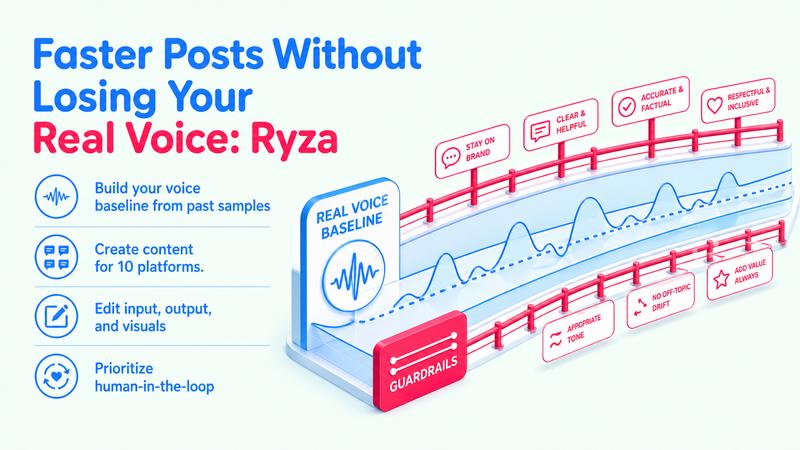
Most AI-generated content fails in an obvious way. It sounds like it was generated. Ryza addresses that with voice training and what it calls meaningful guardrails. The concept is simple: the system learns your writing patterns from your previous content and uses that as a boundary for future outputs.
How voice training works in practice
You submit samples of your existing writing. Posts, articles, or any text that represents how you actually speak to your audience. Ryza analyzes patterns in sentence structure, vocabulary, and tone to build a voice profile. Training takes effect immediately after your first submission and improves as you add more samples over time. If you have content ready to paste in, the process takes less than 5 minutes.
That is the mechanics. The value is what happens next. Instead of creating content “about” your topic in a generic tone, the system aims to create content in your tone. This is where terminology protection becomes important. Strong brands often have signature terms, recurring phrases, and a specific way of framing risk, data, and outcomes. When those terms disappear, your audience feels it even if they cannot explain it.
Guardrails are also operational, not just stylistic
Ryza reinforces voice consistency with daily creation limits based on the needs of different creator types. This is a quality control decision. It prioritizes consistency over flooding the feed with high-volume content that gradually loses the thread of your brand voice.
For business teams, guardrails also show up as compliance oversight across teams and campaigns. If multiple people can generate content, you need boundaries that keep the output aligned. Otherwise, “scale” turns into confusion. The outcome you are aiming for is simple: content that sounds like a real person, but arrives with system-level reliability.
From creator workflow to business system: KPIs, funnels, and ICP lists
A creator can think in posts. A business has to think in systems. Ryza’s Business tier is built around that difference. It includes everything in the Individual tier, plus features designed for revenue and pipeline alignment. The goal is not to turn content into a spreadsheet. The goal is to make content measurable, repeatable, and easier to manage across a team.
Key Business tier capabilities include:
- KPI selections to orient content toward a chosen business outcome.
- Funnel stage targeting so each content run matches where prospects are.
- Persona-based content framing to match message to audience context.
- Compliance oversight to reduce brand and regulatory risk across teams.
- Monthly lists of up to 50 Ideal Customer Profiles (ICPs) and target companies, identified based on your products and services.
- Content calendar planning as an add-on.
- Higher output limits and video creation than individual users.
How this supports ROI thinking without fake certainty
Ryza does not promise guaranteed results. The Terms of Service state the service is provided “as is” without guarantees, and usage limits apply by subscription tier. That is a good thing to be honest about. So where does ROI come from in a grounded way?
It comes from reducing wasted effort. If you can:
- Move from research to posts without rewriting, you save expert time.
- Keep voice consistent across a team, you reduce revisions and rework.
- Target a funnel stage intentionally, you reduce off-strategy content.
- Work from a tailored ICP list, you reduce random outreach.
This is where content becomes like lending decisions. You are allocating limited capital, attention, time, budget, toward the highest-likelihood outcomes. Content that is untracked and untargeted is like risk without a framework. Ryza’s Business tier is essentially an attempt to bring data discipline into creative work without stripping out the human voice.
Privacy, ownership, and policies: what happens to your content after generation
In content creation, trust is not a “nice to have.” It is an operating requirement. That is especially true when you are uploading business documents, research PDFs, or brand assets. Ryza’s policy stance is clear and specific:
- Ryza Content does not store any content you generate on its servers.
- Once your session ends, your posts, newsletters, visuals, videos, and ICP lists are no longer retained by the platform.
- All generated output belongs entirely to you.
- Ryza makes no claim to your content and does not use it to train any models or algorithms.
- Uploaded PDFs and images are processed during your session and cleared when you log out or your session times out.
From a business perspective, this changes the risk profile. Many teams hesitate to use AI tools because they fear losing control of content, data, or brand materials. Ryza’s approach is to minimize retention and clarify ownership.
Ryza’s structure keeps the human in the loop. That is the point. You own the content. You publish the content. And you carry responsibility for what goes out.
Demos, tiers, and practical adoption: choosing a setup that stays consistent
Adopting a content platform fails when it creates new work. The tool feels powerful, but the team cannot standardize how to use it. Or a solo creator generates a lot of drafts, then stops because the outputs no longer feel real. Ryza’s tiering is designed to match those realities.
Individual tier: for consistent personal output
Individual plans are designed for solo creators, solopreneurs, and personal brand builders who want professional content consistently and efficiently. The value is speed plus voice integrity, without the overhead of business analytics and compliance structure.
A practical way to adopt it as an individual:
1) Train your voice with a small set of posts that represent you.
2) Generate LinkedIn drafts from themes you already talk about.
3) Edit in your judgment, then publish yourself via the provided links.
4) Keep a steady cadence rather than chasing volume.
Business tier: for teams that need alignment
Business plans add the controls that teams need: KPI selections, funnel stage targeting, persona framing, compliance oversight, and ICP lists. You also get higher output limits and video creation.
A practical way to adopt it as a business:
- Set a KPI and pick a funnel stage for the next content run.
- Build content from approved source material like PDFs, sales one-pagers, or research.
- Use compliance oversight as a standard gate, not an exception.
- Use the ICP and target company lists to guide what you write into, not just what you write about.
Ryza also supports multiple platforms with built-in formatting profiles, character limits, and tone adjustments. That matters because platform mismatch is a hidden tax. Teams waste time rewriting content that was never shaped for the channel.
Finally, demos matter. If you are evaluating a tool like this, you want to see the workflow end-to-end. Ryza provides a demo videos playlist as part of its “Demos, FAQs, and Policies” hub. Use that to validate fit before you standardize a process.
Case Study / Real-World Example
A small B2B services team wants to post consistently on LinkedIn. They have expertise, but the workflow is messy. The founder writes some posts. A marketer rewrites them. A subject-matter expert flags terminology issues. Then the team abandons the draft because it takes too long.
They choose Ryza Content Creator and start with voice training. The founder pastes in a set of prior LinkedIn posts that reflect their real tone and signature terms. Training takes effect immediately, and the team adds more samples over time to strengthen the voice profile.
Next, they upload a PDF that explains their service process. In one session, Ryza generates a short series of professional LinkedIn posts, each with consistent styling and clear hooks. The team uses funnel stage targeting to keep the series in “Storytelling,” so it reads like a narrative, not a hard sell.
Because they are on the Business tier, they select a KPI and use compliance oversight before anything ships. They also request the monthly list of up to 50 ICPs and target companies based on their products and services, then tailor several posts to the problems those buyers face.
Finally, they publish manually using the direct links. No automated posting. The result is a faster, more controlled workflow that protects brand voice, reduces revision loops, and keeps accountability clear.
Key Takeaways
- Speed is only useful if the content stays real. Ryza’s core value is faster creation with brand voice consistency through voice training and guardrails. That balance lowers rework risk.
- Voice drift is a hidden cost of AI content. Ryza counters it with a voice profile built from your writing, plus terminology protection and styling controls. This keeps your content sounding like you.
- Business teams need systems, not random output. The Business tier adds KPI selections, funnel stage targeting, persona framing, compliance oversight, and content planning options. These features help align content with pipeline thinking.
- Source material matters more than prompts. Ryza supports PDFs and images so you can move from research and data into posts, newsletters, and marketing materials. This helps experts stay focused on insight.
- Privacy and ownership are part of the product. Ryza does not store generated content on its servers after sessions end, does not retain uploads beyond processing, and all output belongs to the user. This reduces data risk concerns.
- Human judgment stays in the loop. Ryza does not auto-post, and users remain responsible for what they publish. That design supports intentional content and clear accountability.
Actionable Next Steps
- Gather a “voice canon” before you generate anything. Pull 3 to 5 past posts or paragraphs that sound most like you. Use them for voice training so the system learns your real tone and terminology.
- Choose one content input per week and standardize it. Pick a PDF, a research note, or a recurring theme and run it through the same workflow. Consistency in inputs leads to consistency in outputs.
- If you are a business user, set a KPI and funnel stage for each content run. Do not generate content without a destination. This keeps your work from drifting into vague thought leadership.
- Build a lightweight approval workflow that matches your risk tolerance. Use compliance oversight and internal review as a repeatable step, not a last-minute scramble. It protects the brand and reduces revision cycles.
- Use the monthly ICP and target company lists to guide story selection. Write into real buyer questions and objections, not just what you want to talk about. That is where content becomes a system.
- Request a demo and validate the end-to-end flow. Watch the demo videos playlist, then test one session from source material to published post. Keep the test small and measurable.
Conclusion
Content creation is not hard because people lack ideas. It is hard because the work sits between creative energy and operational reality. You have to translate expertise into posts, keep the voice consistent, manage risk, and still publish at a cadence that builds trust. Ryza Content Creator is built for that middle space. It treats content like a workflow, not a moment of inspiration. Voice training and meaningful guardrails are the foundation, because speed without authenticity is just noise. The decision not to auto-post also matters, because it keeps judgment and accountability with the user.
For business teams, Ryza goes further by adding structure: KPI selections, funnel stage targeting, compliance oversight, persona framing, and ICP and target company lists. Those are not “nice features.” They are the pieces that turn content into a measurable business system. Just as important, Ryza’s policies focus on ownership and privacy. Your content belongs to you. Generated output is not stored on Ryza’s servers after sessions end. Uploads are processed and cleared when you log out or time out. That stance lowers risk for teams who want the benefits of AI without giving up control of their data.
If you want to create content consciously, the path is clear: keep the voice real, keep the process repeatable, and keep the human in charge.
Implementation Guide
1. Build your voice baseline first. Train your voice using real past content, then generate a small set of posts and compare them to your originals. Update the training set until the tone feels consistent.
2. Create a repeatable “source to post” pipeline. Use PDFs and images as inputs during a session, then generate platform-specific drafts. Document the steps so anyone on the team can follow them.
3. Operationalize quality controls. For teams, use compliance oversight and a simple approval workflow before publishing. For individuals, set a personal checklist for voice, terminology, and clarity.
4. Tie each content run to intent. If you are on the Business tier, select a KPI and funnel stage each time. Treat content like a lending decision: align effort with the outcome you want.
5. Validate privacy expectations internally. Review what Ryza collects, what it does not store, and how ownership works. Then decide which types of source material are appropriate for your use case.