
How Does Your AI Agent Operate?
May 28, 2026
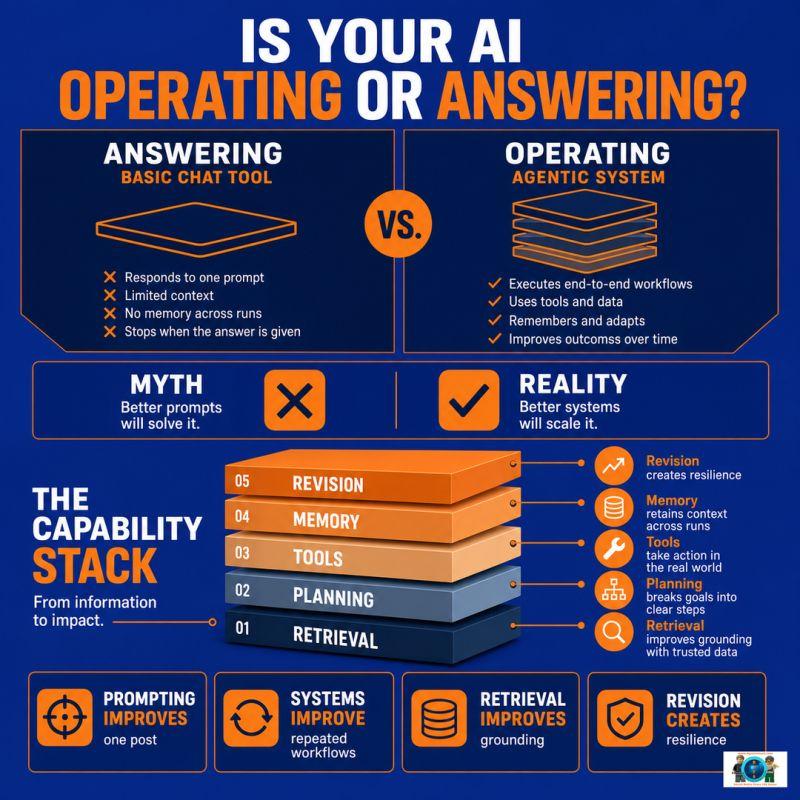
Is your AI answering or operating? A lot of teams say they want an AI agent. What they often buy is a better chat interface.
That gap matters, because answering a prompt and completing a task are not the same system.
Myth vs Reality:
Myth: if a model sounds smart, it can run work on its own.
Reality: autonomy comes from design patterns working together, not from one model alone.
A basic chat tool does one thing well. It responds to the latest prompt. That is useful for drafting content, summarizing notes, or exploring ideas. An agentic system does more. It can retrieve evidence before responding, plan steps in sequence, use tools to act, store memory across interactions, and revise outputs when something fails or new information appears. Each layer adds capability but also control needs.
Key Takeaways:
• Prompting vs systems. A strong prompt can improve one post, but a system is what improves every repeated workflow.
• Retrieval before response. If accuracy matters, give the model access to evidence instead of asking it to guess from memory.
• Tool use with limits. Let agents take actions only where permissions, logging, and rollback are clear.
• Revision loops matter. The ability to check and improve an output is often what separates a demo from a dependable operating model.
AI autonomy is not magic. It is a stack of choices about how the model, tools, memory, and review process work together.
That gap matters, because answering a prompt and completing a task are not the same system.
Myth vs Reality:
Myth: if a model sounds smart, it can run work on its own.
Reality: autonomy comes from design patterns working together, not from one model alone.
A basic chat tool does one thing well. It responds to the latest prompt. That is useful for drafting content, summarizing notes, or exploring ideas. An agentic system does more. It can retrieve evidence before responding, plan steps in sequence, use tools to act, store memory across interactions, and revise outputs when something fails or new information appears. Each layer adds capability but also control needs.
- Retrieval improves grounding.
- Planning improves task structure.
- Tools create action.
- Memory creates continuity.
- Revision creates resilience.
Key Takeaways:
• Prompting vs systems. A strong prompt can improve one post, but a system is what improves every repeated workflow.
• Retrieval before response. If accuracy matters, give the model access to evidence instead of asking it to guess from memory.
• Tool use with limits. Let agents take actions only where permissions, logging, and rollback are clear.
• Revision loops matter. The ability to check and improve an output is often what separates a demo from a dependable operating model.
AI autonomy is not magic. It is a stack of choices about how the model, tools, memory, and review process work together.
This blog and image were created using Ryza Content Creator, our AI-adjacent content creation system that allows you to convert your ideas into polished, branded posts faster!