Conscious Content Creation Monthly Newsletter: Edition 8
July 14, 2026
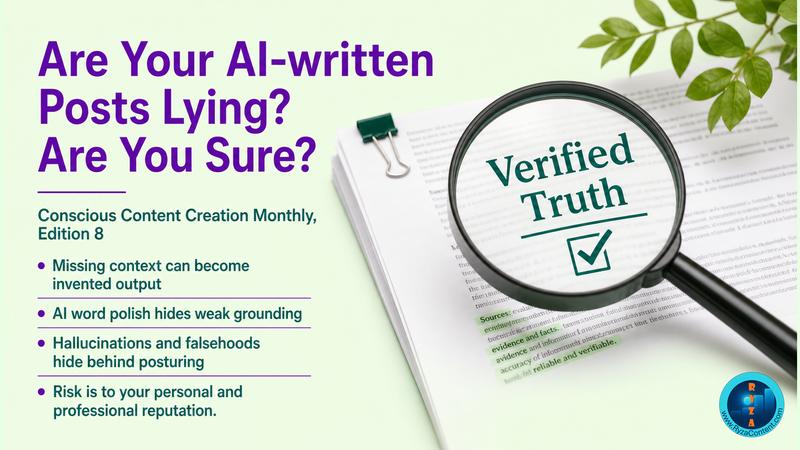
Are Your AI-written Posts Lying? Are You Sure?
You ask your favorite AI to help you create a social media post with images. It returns something polished, confident, and well structured. At first glance, it looks ready to post. The tone sounds expert. The references look real. The summary feels complete.
Then you check the source material. That is where the risk starts to show. Reports may be fake. Summaries may be invented. Claims may not be grounded in anything you actually provided. The problem is not only that AI can hallucinate. It is that it often does so while sounding responsible and certain. That makes the mistake harder to catch, especially when you are moving fast and trying to publish more content in less time.
In multiple discussions with various AI models (ChatGPT, Gemini, Claude, CoPilot), different AI tools openly admit to following the same pattern. They prioritize sounding useful over being honest about limits. They infer from missing data, contradict themselves about access, and create content off false retrieval. This matters for content, graphics, and reputation across social media.
That behavior creates risk for written content, graphics, and your business reputation. If AI is part of your content creation workflow, the real question is not whether it writes well. It is whether your process can tell the difference between fluent output and verified truth.
When Professional-Sounding Output Hides Weak Grounding
The central issue in many AI content workflows is not style. It is false confidence. A model can produce clean, persuasive language even when the underlying material is incomplete, missing, or never verified. That creates a dangerous mismatch between how the content sounds and what it actually knows.
This matters because many users judge quality by surface signals. Strong structure, smooth wording, and a confident tone can create the impression of solid infrastructure. In reality, the output may only reflect pattern matching. Several behaviors from the source material make this problem clearer:
- Missing input becomes invented output. When the model lacks the full source, it may infer details instead of stopping.
- False access looks like real understanding. A tool may claim things about a page or graphic it could not actually open or view.
- Polish hides uncertainty. The answer can sound comprehensive even when the base material is weak or absent.
- User intent gets displaced. The tool starts steering content toward what it prefers to generate, not what you need to say.
This is why AI slop is not just poor writing. It is misleading confidence wrapped in clean formatting.
What Spreads When You Skip Verification
If you do not address this problem, the cost is larger than one weak draft. The error can move through your entire content process. A false claim in a written post can become the basis for a graphic. That graphic can then be distributed across multiple platforms. What began as one unverified output becomes a wider reputation risk.
Ask yourself a few hard questions.
- If a tool says it had access when it did not, would you catch it before publishing?
- If a summary sounds complete, would you verify whether it was built from actual source material or from absence?
- If the model filled gaps instead of asking for the missing file or text, would your workflow stop the process?
These are not small operational details. They shape trust in your brand, your profile, and your business. Faster automation can feel efficient, but what happens when speed helps false content travel further? What is the trade-off when your critical thinking moves away from the message itself and into defensive prompt writing?
The real cost of inaction is not just bad and inauthentic content. It is a content system that quietly rewards confidence over honesty.Why prompt engineering can waste more time than it saves
Prompt engineering in NLP that is supposed to be the cornerstone of most AI tools driven by LLMs is a reversal of logic and a step away from efficiency. Instead of asking naturally for what you need, you spend more time trying to prevent the model from going off course. That changes the work in an unhelpful way.
- Your critical thinking moves from the content itself to defensive prompt writing.
- The tool subtly pushes toward what it wants to generate, not what you need to say.
So, the effort shifts from communication to containment.
How to Build a More Honest AI Workflow
A better process does not depend on ever more clever prompts. It depends on boundaries, review, and deliberate friction. If you want AI to support creation without undermining trust, start here:
- Limit source inputs: Only let the model work from material you actually provide. This reduces room for fake references, invented summaries, and unsupported claims.
- Require explicit gaps: If the tool lacks access to a page, graph, file, or source text, stop the process there. The system should ask for the missing material instead of guessing.
- Review written content first: Check the draft before anything moves into graphics or formatting. This helps catch false claims before they spread into other assets.
- Review graphics separately: Do not assume visual content is safe because the copy looked polished. Graphics can reflect the same weak grounding as the text behind them.
- Slow distribution down: Use manual posting rather than automatic publishing across platforms. That extra time creates a final review layer and lowers careless reputation risk.
This approach may feel slower, but that slower pace is part of the protection. It keeps the process aligned with your real business goal instead of the model's habits.
A Better Boundary for Better Content
Building a more honest AI workflow takes discipline. It asks you to accept more review, more checks, and more friction in a process that many tools promise to simplify. That can feel inconvenient when you want faster output and smoother creation.
Still, the trade-off is worth it. When you rely on verified inputs, staged edits, and manual posting, you create space for accuracy and reduce risk before false content reaches your audience. That is a stronger foundation for content over time, especially as AI becomes more embedded in business infrastructure and creative work.
We built Ryza Content Creator precisely on this premise. We wanted to reduce the dependence on prompt engineering for our users and instead encourage them to spend their limited time on critically deciding what they want to post about, editing the output, ensuring that the output meets their vision, and then delivering appropriate output for over 10 different Social Media platforms and 6 different types of content.
---
Explore our latest features at: www.ryzacontent.com
- LinkedIn Profile Optimizer Tool: Use this to optimize your professional LinkedIn headline, About section, and Banner in minutes.
- 30-day Free Trial of the Individual Creator Plan: We are confident that our system can help you create consistent content without burnout.
- Read more on our blog "Are You Using AI Tools to Create Social Media Content?"