How to Create Content Faster Without Risking Your Reputation
May 01, 2026
Content creators rarely struggle with ideas. They struggle with translating their expertise into authentic posts because time is at a premium. Their thoughts continue to exist in PDFs, notes, comments, visuals, and subject-matter interviews. And using AI tools often results in generic posts full of word salads.
You need a system that helps you turn source material into professional social posts, newsletters, and marketing materials faster, while protecting your voice with guardrails. The point is not full automation. The point is a more reliable workflow. It is possible to achieve this with AI agents that are trained to handle different parts of your content creation process. One to assimilate and identify key thoughts of your inputs, another to create the output text content for various platforms, and yet another to create images or videos.
If each of these agents were trained in your own voice, the resultant output can be fairly streamlined and can represent your brand consistently. The problem is that most people do not always have the time or the necessary skillset required to create these agents in a reliable manner. Many clients we have talked to bemoan the low quality of AI generated output even from some of the big-name tools that auto post on platforms on users' behalf.
The issue is that while auto posting saves time, the quality of the posts can damage your reputation. And the trade-off is usually not worth the costs! The bigger idea is simple. Speed only helps when quality stays intact. If your process creates more drafts but more voice drift too, you have not really gained anything.
For bigger businesses relying on internal teams or external services to create content, this risk compounds over time. And if you are not monitoring what is being posted in your name, you are handing over judgment to an unfettered AI tool somewhere.
Key Ideas:
- Use voice training to build a real baseline based on your past writing. That helps protect terminology, tone, and consistency across future drafts.
- Guardrails are not just stylistic. They also support quality control, approval needs, and compliance oversight for teams.
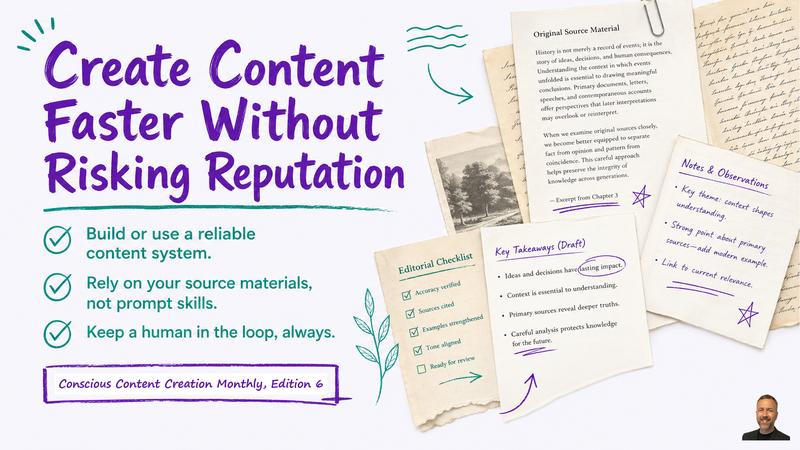
- Source material matters more than clever prompting. PDFs, themes, and images give the system more real context to work from.
- Business use need's structure. Funnel stage targeting, persona framing, and ICP lists help teams write into real buyer context.
Why it Matters:
For business teams, wasted effort often hides in rewrites, off-brand drafts, and scattered approvals. A better content system reduces rework risk, shortens cycle time, and keeps customer-facing language fair, clear, and consistent. Start by defining approved inputs, voice standards, and one review path before you scale output.
How Ryza Content Creator is a Different System:
Ryza Content Creator is built around the key ideas discussed above, which makes the entire system and approach different from other creation tools. We do not want to be everything for everyone. We want to be the system that helps you create and post content efficiently but consciously. We are a one-stop-shop for creating only. That distinction matters.
- Ryza does not auto-post. Users publish manually through direct links, which keeps judgment with the team.
- It also does not store generated content on its servers after sessions end, and all output belongs to the user.
- For teams managing brand, compliance, and data risk, those choices shape adoption.
- Ryza’s approach is to move source material into publish-ready content with structure, not noise.
- Ryza does not retain or save any inputs or outputs created by users to protect brand privacy.
Whether you use Ryza or any other system, including your own, to create content, keep your eye on the end goal. Are you creating content with a purpose or are you just creating content to add to the noise?
Actionable Insights:
- Gather 3-5 strong writing samples and use them as your voice baseline before generating outputs.
- Run one approved PDF or research note through a repeatable source-to-post workflow each week.
- Set a target audience for every content session so the draft matches the story you need to tell.
- Edit final drafts for terminology, compliance, and brand risk before publishing.
- Review your target customer lists and write content that addresses their pain points.
Metric to Watch:
Revision rounds per published post. It matters because extra edits often signal voice drift, unclear source material, or weak approvals. Reduce it by tightening your voice canon, using better inputs, and checking terminology before drafts go live.
Start small. Test one session from source material to final post, then document what worked.
Closing Note:
Leaders do not need more content for its own sake. They need content that turns real expertise into clear market communication, with less risk and more control. The best systems keep the human in charge while making the work easier to repeat.
Read our full blog on this topic: "Faster Posts Without Losing Your Real Voice: Ryza" https://www.ryzacontent.com/blog?post=1777464484.942294