
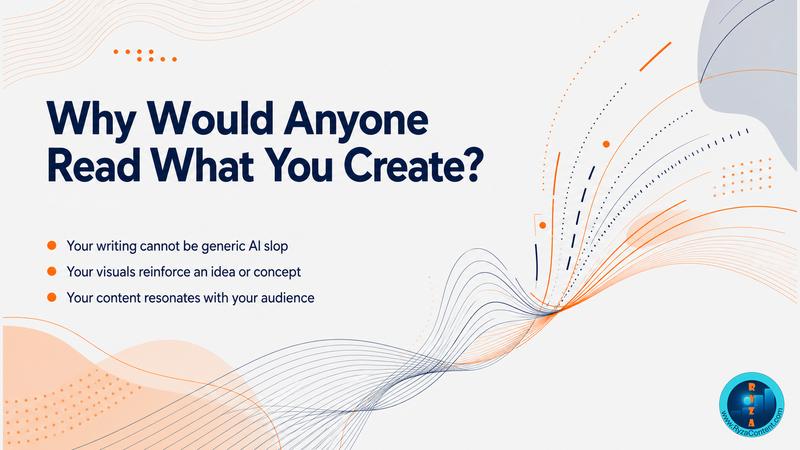
Conscious Content Creation Matters More Than Speed
July 30, 2026
We have gotten really good at making more content, faster. That part is obvious now. A tool can generate polished words, colorful visuals, and endless variations in minutes. However, the harder question is whether any of it deserves a reader’s attention in the first place.
Most content tools are built around speed, volume, and output limits. But conscious content creation starts earlier than the writing itself. It starts with the way the tool behaves, the way the interface guides decisions, and the way visuals and words are shaped before anything gets published.
A cluttered UI says something. A decorative infographic says something. A fluent social post that teaches nothing says something too. Across all three, the signal is the same: more was added than needed, and not enough was questioned.
Let us walk through that connection, together. We start by observing how conscious content creation spans across three layers: interface, visuals, and written content. Then we will ground it in a practical publishing workflow using Ryza Content Creator’s updated platform coverage and output tiers. Because speed is useful, sure, but only when it helps you create something worth reading.
How Clean UX/UI Shapes Better Content Decisions
A clean interface does more than look nice. It tells you someone has thought carefully about your experience before asking for your time. That matters because the tool itself sets the tone for the work created inside it.
When a UI is crowded with competing calls-to-action and inconsistent visual weight, it creates friction in the wrong place. Instead of helping you focus on the goal, it pulls your attention in too many directions. Whether it is your LinkedIn profile or your website, if there is no bridge between what you are claiming and what you are demonstrating, they all just become words that make no impact on anyone.
How this works in practice:
- A clear layout and sequence reduce decision noise and support better judgment.
- Fewer distractions make it easier to focus on what actually serves the reader.
- Design discipline reinforces content discipline by rewarding restraint.
Why Infographic Clarity Matters More Than Visual Decoration
A useful infographic helps someone hold a complex idea in their head after just a few seconds. That is the standard that matters. Extra icons, gradients, and visual flourishes can look creative, but they don’t automatically improve understanding.
A strong infographic does a few things well:
- It reduces complexity instead of adding visual noise.
- It teaches a concept faster than a block of text would.
- It respects the reader’s time by making the point easy to grasp.
How AI Content Becomes Empty Writing with Perfect Fluency
This is where a lot of people focus now, and fair enough. AI can produce fluent writing at scale. But fluent language was never the difficult part. The real risk is confusing fluency with value.
A post can be smooth, structured, and confident while still saying nothing new. That is what empty writing looks like. It appears substantial on the surface, but it leaves the reader exactly where they started.
What gives content real value:
- A reader learns something, questions something, or can do something new.
- The post comes from a real idea, real data point, or real experience.
- Publishing includes friction, like verified inputs and human review.
Why Conscious Content Creation Is One Discipline Across Three Layers
Here is the big idea: UI, infographics, and writing aren’t separate quality issues. They are expressions of the same discipline. In each case, the work improves when someone is willing to cut what doesn’t serve the actual goal.
That means:
- Clean interfaces support cleaner decisions.
- Clear visuals respect attention better than decorative ones.
- Real inputs create stronger content than pattern-matched averages.
When those layers align, the result feels intentional. And intentional content tends to earn attention rather than just occupy it.
A Practical Publishing Workflow with Ryza Content Creator
Ryza Content Creator frames a workflow around protecting brand voice and reputation while still increasing output. More capacity only helps when the process stays selective and sufficient guardrails are in place, even when it seems like one-too-many steps at times.
Ryza now serves 10 platforms and has expanded output limits across tiers.
- An Individual Creator, which includes a 30-day free trial, can create 1 post per day plus up to 6 shorts or reels per month.
- An Influencer Creator can create up to 15 shorts or reels and 90 posts per month.
- A Solopreneur or Business Creator can create up to 50 shorts or reels and 200 posts per month.
What stands out is how this can support diversification without forcing sameness. A creator can spread posts across multiple platforms as required, while still protecting quality through review, clearer inputs, and selective publishing. So, the workflow isn’t just based on generating everything possible, quickly. It is designed deliberately to expand reach, by meeting different criteria, and then requiring you to apply your judgment at every layer before posting on any social media. The same story presented in distinct ways, consciously creating content for your consumers!
Where Faster Output Starts to Undercut Reader Value
This is usually where the trade-offs show up. Once output capacity increases, the temptation is to fill every available slot. More posts, more visuals, more platforms.Sounds productive? Sometimes it is but more often, it is just faster noise. Don't fall into this trap of pushing content out like a machine. Create with a plan, consciously.
A few questions are worth asking:
- Are you publishing because the content adds value, or because the system made production easy?
- Are your visuals helping people understand faster, or just making the post look fancy?
- Does your interface encourage thought and action, or does it just sit there aimlessly?
The underlying risk is brand erosion. Not through dramatic failure, but through repetition, emptiness, and reader fatigue. A quick solution exists in the process described here: use verified inputs, keep human review in place, and exercise restraint even when the model can produce much more.
Steps To Create Content People Actually Want to Read
- Start with reader respect: Review your tool, layout, and publishing flow before drafting content. A messy experience upstream often leads to messy decisions downstream.
- Strip out visual noise: Look at every infographic or visual asset and ask whether it teaches faster than text. Keep only the elements that improve understanding.
- Check for real inputs: Build posts from actual ideas, data, or experience. That gives the content a point of view and reduces the risk of generic output.
- Add process friction: Require human review before publishing. A little friction helps protect quality, brand voice, and better decisions.
- Use capacity selectively: Expanded output limits and multi-platform publishing are useful when they support diversification with intention. Don’t mistake available volume for required volume.
Where Conscious Content Creation Leads Next
The deeper point here isn’t that speed is bad. Speed is useful. AI can absolutely help creators and businesses produce more across more platforms. Ryza Content Creator’s expanded platform support and higher output limits show that scale can be practical. But scale becomes meaningful only when it serves something with substance.
The same discipline shows up everywhere: in a clean interface, in an infographic that actually teaches, in a post that leaves the reader with a new idea, a sharper question, or something practical to act on. That discipline is really about respect, for the user, for the reader, and for the decisions behind the work.
Conscious content creation feels stricter because it asks more of the process. It asks you to question what gets added, what gets removed, and what deserves to be published at all.
And maybe that’s the question worth pondering: when content gets easier to produce every day, how do you decide what is still worth someone else’s time?