Conscious Content Creation Monthly Newsletter: Edition 9
August 13, 2026
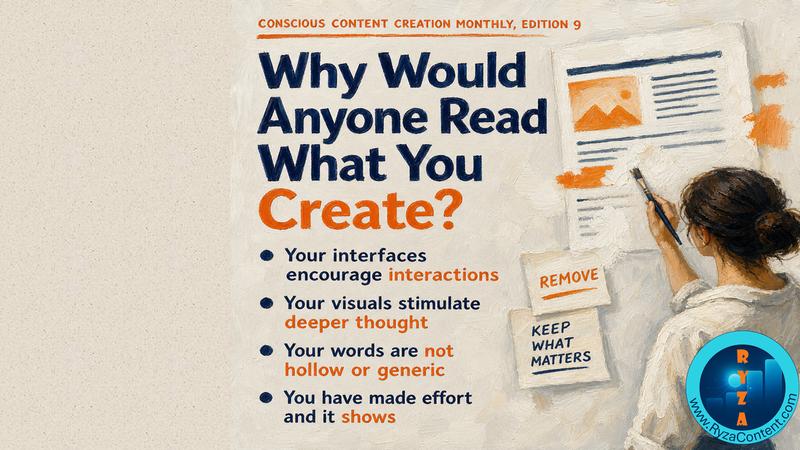
Why Would Anyone Read What You Create?
You can now generate more content than ever. More posts, more shorts, more platform coverage, more output in less time. For many teams and creators, that sounds like progress. But a harder question sits underneath all that speed. Should anyone read what comes out the other end?
That question starts earlier than most people think. It starts before a single caption is drafted or an infographic is exported. It starts with the impact of your profile or website. A cluttered interface, crowded with competing calls to action and uneven visual weight, sends a message before a single word appears. It suggests that nobody made careful decisions about the person who is going to view or use it meaningfully.
Readers feel that same lack of discipline in the content they receive. They see it in visuals that look creative but explain nothing. They see it in fluent posts that sound polished yet leave no real takeaway behind.
The common thread is simple: when speed becomes the main optimization, respect for the audience gets pushed aside.
This edition looks at one discipline applied across three layers: interface, visuals, and words, and why conscious content creation depends on all three.
When Interface, Visuals, and Words Follow the Same Discipline
Most discussions about AI content focus on writing quality. That focus misses the deeper issue. Fluent output was never the hard part. The harder challenge is whether the system behind the output helps create something clear, useful, and worth a reader's time.
The same discipline shows up across the whole content chain. It is the discipline to cut what does not serve the goal, even when leaving it in would be easier.
- Interface sets the standard: A clean UX/UI is a signal of respect. When a tool or a profile or a website is intentional and uncluttered, it tells users their attention matters and encourages more interaction.
- Visuals must teach fast: A good infographic helps someone hold a complex idea in their head beyond five seconds. Color, icons, and gradients only help when they serve clarity.
- Fluency can hide emptiness: A post can be grammatically correct, structured, and confident, yet still add nothing. Empty writing becomes slop when polish gets mistaken for value.
- Real inputs create real value: Useful content comes from a real idea, a real data point, or a real experience. It needs verified inputs, human review, and restraint before publishing.
Viewed together, these are not separate content concerns. They are connected decisions that shape whether your output earns attention or simply occupies it.
What Faster Noise Costs Your Brand
When output grows faster than judgment, the cost does not always show up immediately. Content still gets published. Feeds still stay active. Metrics may even suggest that the machine is working.
But what are readers actually taking away? Are they learning something, questioning something, or able to do something new after reading? Or are they consuming polished language that disappears from their minds, the moment they scroll on?
There is a professional risk here for creators and brands. If your interfaces (profiles, websites, tools) feel careless, your visuals feel decorative, and your writing feels statistically assembled, what does that signal about your standards? What happens to trust when every piece looks finished but none of it feels grounded in anything real?
There is also an opportunity cost. Every post that says nothing uses time, attention, and brand space that could have been spent on something sharper. Every infographic that decorates instead of clarifies trains your audience to ignore the next one.
Every unnecessary element left in a workflow makes it easier to produce more, but harder to produce something people remember. Faster output can help but faster noise only compounds the problem.
How to Build More Conscious Output
If you want better content decisions, start by introducing useful friction into the process. The goal is not to slow everything down for appearance's sake. The goal is to make sure speed still serves something worth saying.
- Audit interface signals: Review the experience your interfaces (profiles, websites, etc.) give users when they land on them. If the interface feels cluttered or full of competing (or worse, absent) action items, simplify it and remove what does not support your actual goal.
- Test infographic clarity: Look at each visual in your outputs and ask one question: can someone understand a complex idea faster here than they could through text alone? If the answer is unclear, remove decorative elements that add noise without helping comprehension.
- Check for real inputs: Before drafting content, identify or utilize a real source behind it. Ground each post in a real idea, a real data point, or a real experience so the output has substance beyond fluent phrasing.
- Require human review: Put a person between generated outputs and publication. That review should verify inputs, assess whether the piece actually teaches something, and identify empty content that only sounds complete.
- Publish with restraint: Do not release everything your favorite AI model can create just because the capacity exists. The stronger decision is often to cut, condense, or hold back content that does not earn its place.
- Individual Creators can create up to 6 shorts or reels per month in addition to 1 post per day (comes with a FREE 30-day trial).
- Influencer Creators can create up to 15 shorts or reels and 90 posts per month.
- Solopreneur & Business Creators can create up to 50 shorts or reels and 200 posts per month.
A Better Standard for More Content
Conscious content creation does ask more from the people and systems behind it. It asks for restraint, cleaner decisions, verified data, and a willingness to remove what does not serve the reader. That takes effort, especially when faster output is always available.
Still, this is the standard worth keeping. More content only helps when the interfaces respect the audience, the visuals respect the viewer, and the words respect the reader. As you create more, what signals are your tools and your content sending before anyone finishes the first line?
Read Original LinkedIn Newsletter by Timothy Goebel: https://www.linkedin.com/pulse/why-would-anyone-read-what-you-create-timothy-goebel-wnyrc/